
Pixel art is often described as a consequence of technical limitation.
In football video games of the 1980s and 1990s, however, pixel art became much more than that: it evolved into a visual language capable of communicating tactics, movement and identity with remarkable clarity.
Long before realism and licenses defined sports games, football was rendered through pixels — simple shapes that invited interpretation, imagination and memory.
The Origins of Pixel Art in Early Football Games
In the early 1980s, hardware constraints dictated every visual choice.
Screens were low-resolution, color palettes were limited, and memory was scarce. Developers were forced to reduce football to its essentials:
- players as small clusters of pixels
- the pitch as a flat, geometric surface
- the ball as a single moving point
Yet these limitations produced clarity.
Players immediately understood what they were seeing.
Pixel art did not aim to reproduce reality.
It aimed to represent the logic of the game.
Abstraction and Readability
Early football games relied on abstraction to remain playable.
Top-down and side-on perspectives simplified:
- spatial awareness
- passing lanes
- player positioning
In titles like International Soccer, pixel art allowed players to read the pitch as a system rather than a scene.
This abstraction mirrored how football was discussed culturally at the time — through formations, zones and movement rather than individual animations.

Pixel Art and Tactical Thinking
One of the most important contributions of pixel art football games was tactical clarity.
Because players were represented symbolically:
- spacing became obvious
- movement patterns were readable
- formations were visible at all times
This encouraged players to think like managers and tacticians.
Games such as Kick Off and Kick Off 2 emphasized speed, precision and positional awareness, all made possible by minimalist pixel representation.
Pixel art transformed football into a dynamic diagram.
The Early 1990s: Pixel Art Reaches Maturity
The early 1990s marked the peak of pixel art sophistication in football video games.
Improved hardware allowed:
- smoother animation
- richer color palettes
- more expressive sprites
Yet developers resisted realism.
They refined abstraction instead.
The result was a visual language that felt complete and intentional.
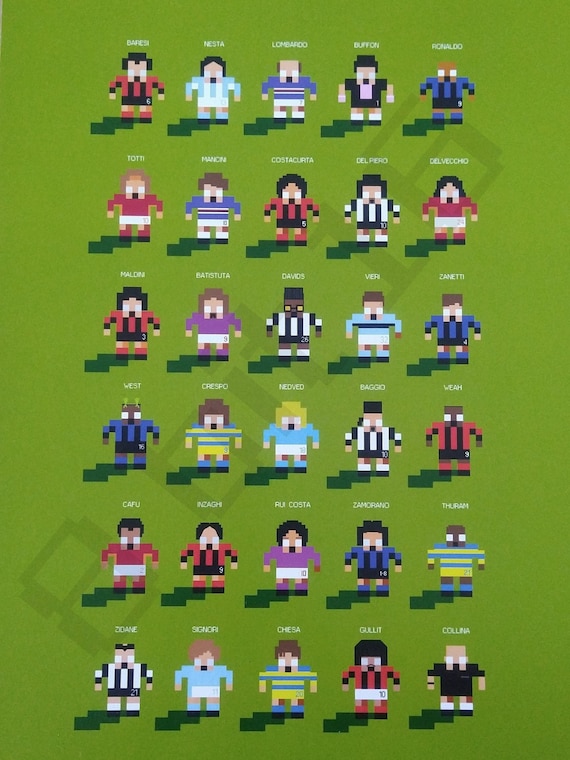
Sensible Soccer and the Codification of Pixel Football
No game defines pixel art football better than Sensible Soccer.
Its design philosophy was radical:
- extremely small player sprites
- minimal animation frames
- high-speed movement
- perfectly readable formations
Despite its simplicity, the game conveyed:
- momentum
- balance
- tactical flow
Pixel art here was not decorative.
It was functional excellence.
For many fans, Sensible Soccer represents the purest visual expression of football ever created.
Pixel Art as Emotional Trigger
Pixel art football games rely heavily on recognition rather than detail.
A few pixels arranged in motion are enough to evoke:
- a sliding tackle
- a long pass
- a goalkeeper save
This minimalism leaves space for memory.
Players project real football experiences onto abstract visuals, creating a stronger emotional connection than high-fidelity graphics often allow.
This is why pixel art football imagery remains powerful decades later.
Arcade Pixel Art vs Home Systems
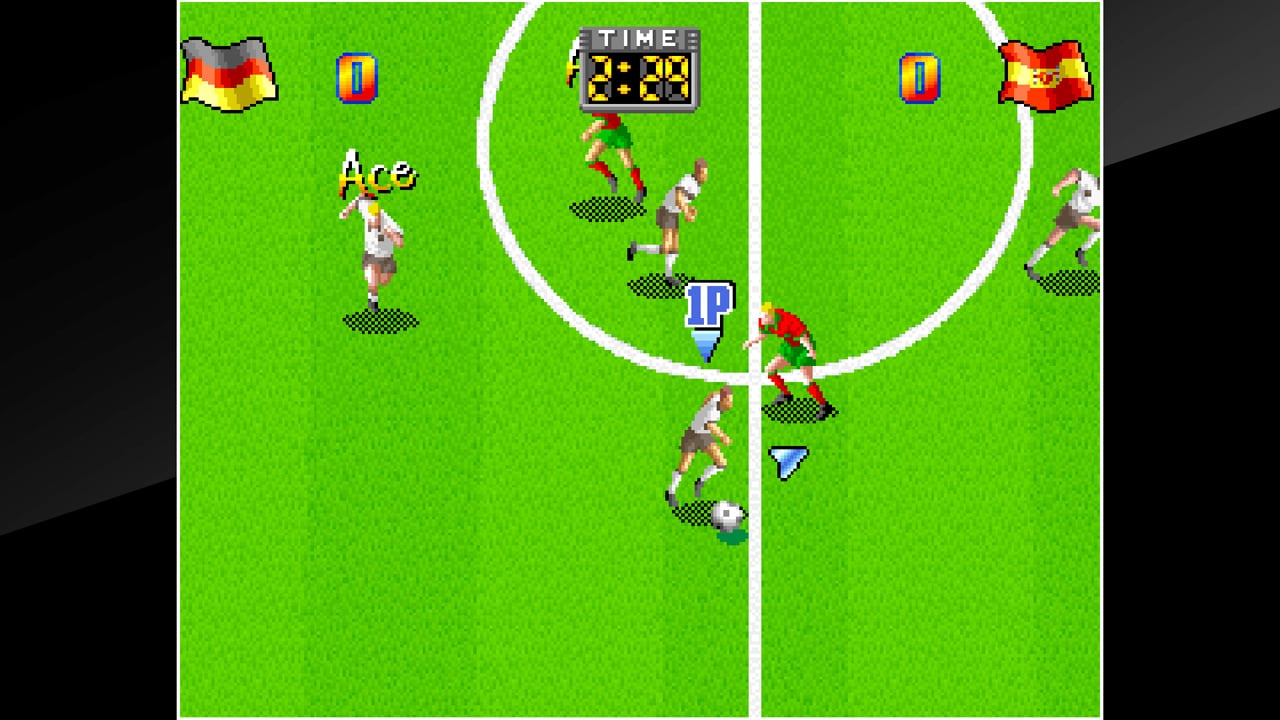
Pixel art evolved differently in arcade football games.
Arcade systems emphasized:
- larger sprites
- bolder colors
- exaggerated animation
Games like Super Sidekicks used pixel art to maximize spectacle and instant recognition.
Home systems, by contrast, focused on:
- precision
- tactical depth
- longer sessions
Both approaches used pixel art, but for different cultural purposes.
Color, Contrast and Identity
Pixel art football games relied heavily on color logic.
With no room for detail:
- shirt colors defined teams
- contrast separated players from pitch
- movement was enhanced through palette choice
This reinforced team identity visually, even without logos or licenses.
Color became a storytelling tool.
Pixel Art and Memory Formation
Pixel art plays a unique role in how football video games are remembered.
Because visuals are symbolic rather than realistic, memory retains:
- shapes
- colors
- movement patterns
Not faces or textures.
This symbolic memory aligns perfectly with how football itself is remembered culturally — through moments, formations and atmosphere.
The Transition Toward Realism
By the mid-to-late 1990s, football video games began moving toward realism.
3D graphics, licenses and broadcast presentation started replacing pixel art abstraction.
While technically impressive, this shift changed the relationship between player and game.
Football became something to watch rather than interpret.
Pixel art football did not disappear — it became nostalgia.
Pixel Art as Cultural Reference Today
Today, pixel art football visuals are widely referenced in:
- graphic design
- illustration
- independent fashion
- retro-inspired games
These references are instantly recognizable to those who experienced football gaming in the 80s and 90s.
They evoke:
- simplicity
- clarity
- emotional memory
Pixel art has become shorthand for authentic football culture.
Why Pixel Art Still Matters
Pixel art in football video games matters because it represents:
- understanding over spectacle
- systems over surfaces
- memory over realism
It reminds players that football is, at its core, about movement, space and timing.
These qualities are often clearer in abstraction than in simulation.
Conclusion
Pixel art in football video games of the 1980s and 1990s was not a technical compromise.
It was a visual language shaped by necessity, refined by creativity and remembered through emotion.
By reducing football to pixels, developers captured its essence more effectively than realism ever could.
That is why pixel art football continues to resonate today — not as a relic of the past, but as a timeless way of seeing the game.